
Trashy App
Mobile App
Nov 2019
Trashy App is an application in collaboration with a machine, Trashy Center, to solve the problem of plastic waste, especially bottles and glasses. Users can throw the plastic waste into the Trashy Center and get points on the Trashy app. Points earned can be exchanged for money or donated to environmentally friendly events. Users can also get information about waste management and environmental conservation in this application.
Awards - Recieved 1st place for UI/UX Design Competition at Technofest, Multimedia Nusantara University, Gading Serpong, Indonesia.
Team
Stevany
Jihan Maulana Octa
Chelsy Lifardy
George Matthew Limongan
Role - UI/UX Designer
Main contributed in problem research, user experience research, user interface design, prototyping, and usability test.
Background
The high population density is directly proportional to the amount of waste in the community today. Based on data obtained from the Indonesian Plastics Industry Association (INAPLAS) and the Central Statistics Agency (BPS), plastic waste in Indonesia reaches 64 million tons per year and 3.2 million tons is known as plastic waste disposed into the sea (Puspita, S., 2018). In fact, as reported by World Atlas, the use of plastic bottles in Indonesia in 2018 reached up to 4.82 billion and beverage bottles are the most types of plastic waste.
Current efforts to overcome plastic waste is recycling. However, recycling has not been effective enough in social life because the level of motivation to recycle is still very minimal. As a result, based on data from Sustainable Waste Indonesia (SWI) less than 10% of plastic waste is recycled and more than 50% still ends up at landfills. Therefore, we want to create a new motivational app that can increase people's motivation in disposing of trash, especially plastic bottles.
Design Process
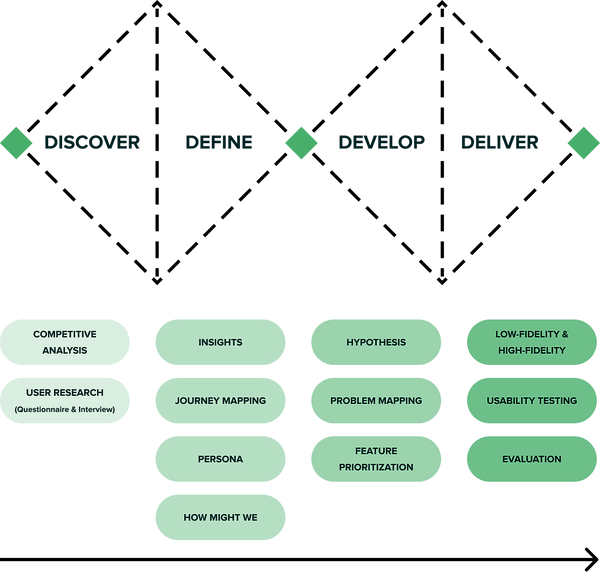
Double Diamond
Discover
Competitive Analysis

The existing applications help reduce waste by providing conveyance waste service or service for purchasing recycled waste that has been sorted. They focus on the large-scale business process. However, usually plastic bottle is consumed individually.
User Research
Our target for this app will be young people because they're classified as productive age, tech-savvy, and has a high frequency in the use of plastic bottles or glasses. Then, we conducted online survey with 200 participants and interview 5 of them. We simply asked several question around their plastic bottle consumption & throwing plastic bottle behavior, pain points, and the whole end-to-end process.
Define
Insights
-
Waste sorting behavior is still very minimal at home and public spaces.
-
They only do waste sorting if there are categorized/recycling bins around them.
-
Recycling trash bins have not been facilitated properly. Sometimes they're easy to find, sometimes they can't be found.
-
Sometimes they still littering simply because they are lazy or forget to throw their trash away.
Journey Mapping
We created journey mapping to find their pain points and opportunities based on their behavior throwing plastic bottle.

Persona
After analyzing the research, we created a persona that represent users who will use our application.

How Might We
-
How to increase motivation for disposing of trash, especially plastic bottles in recycling bins?
-
How to facilitate convenient recycling bins?
Develop
Hypothesis
Our team believe that by giving value to each plastic bottle thrown in recycling bins will increase the motivation for disposing of trash. With notes, the number of special bins that are placed must be large, clean, and easy to find.
Ideation

Deliver
As an UI/UX designer in our team, I was responsible for designing the interface design for withdraw points feature & history and make the prototype of Trashy App. I also participated to help my team for designing the find us and scan feature. Our team designed the low-fidelity design first, then the high-fidelity design. We used the high-fidelity design for usability testing. We always reviewed the design together before we conduct usability testing. We designed the high-fidelity design through 2 iterations.
Low-fidelity

High fidelity & Prototype

Trashy Center

Usability Testing
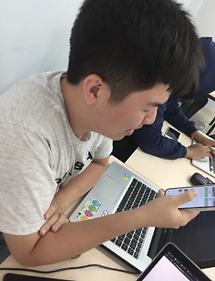
In designing our product, usability testing is needed to identify the truth, completeness, and quality of the product we developed. In addition, testing is also needed to check whether the design of products that have been made are in accordance with product objectives and user needs.
In this case, Trashy will be tested using a usability testing technique to 5 participants. The scenario used for usability testing consist of 5 tasks for testing the homepage, withdrawing points, donations, find us, and news.
Evaluation
1. Users misunderstand when they want to find the nearest Trashy Center. When the users see information under the search bar, users think that the information is a search history. Therefore, we add the "Nearby Trashy Center" title above the information.

2. Users thought the placeholder in withdraw balance input as disabled state and can't be filled. Therefore, we clarify the placeholder as example by adding “e.g.” to explain that it just an example.

3. When users click the points recommendation, users don't aware that the balance input is auto filled because the color is same with placeholder color. Therefore, we change the color to differentiate placeholder and auto filled input.

Moment of Appreciation

